
SPRING-HEELED JACK
London in the 19th century was the world’s largest commercial empire, renowned for its diversity and bustling trade. However, it was also infamous for extremely unpleasant living conditions. New factories produced thick smog that blanketed the city, the high streets were filled with mud and animal waste, and the River Thames served as a dumping ground for human waste. Most newcomers to London worked twelve-hour shifts in factories, crowded in noisy, smoke-filled rooms.
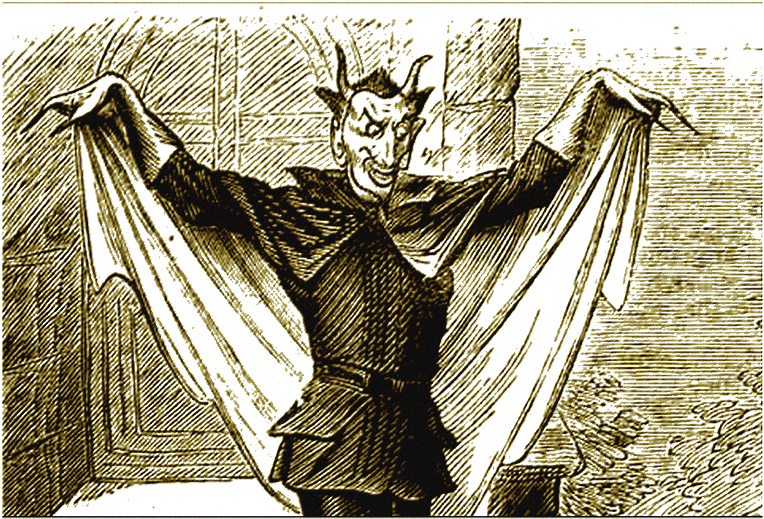
Before Jack the Ripper stalked London’s streets, another phantom had already gripped the city’s imagination: Spring-Heeled Jack. First reported in 1837, this eerie figure was said to be anything but human, leaping over walls and rooftops with impossible agility, vanishing before anyone could catch him. His sudden appearances, blazing eyes, and gravity-defying escapes sent waves of panic through Victorian London, turning him into one of the era’s most unsettling legends.
In several unsettling incidents, police responded to quiet neighborhoods after women reported frightening attacks at their doors. Each time, the mysterious assailant vanished into the night before help arrived. Spring-Heeled Jack seemed to target women, slashing at them with clawed hands the moment they opened the door, leaving behind only screams and confusion.

As the tales spread, the legend of Spring-Heeled Jack ballooned into something almost mythic. Newspapers, once eager for the story, eventually pulled back as the reports grew too wild to believe. Some claimed he leapt across rooftops like a demon spewing fire, while others insisted he had the hulking body of a bear. Each retelling made him less human and more of a nightmare.
In January of 1838, the Mayor of London, John Cowan, addressed the attacks, believing them to be the work of a ‘gang of wealthy jerks,’ since nothing was stolen, and whoever the assailant or assailants were, they were only looking to scare.
In February, the fear surrounding Spring-Heeled Jack erupted into public frenzy when a woman named Jane Alsop became one of his most notorious victims. She answered a frantic knock at the door to find a man claiming that Jack had been captured and desperately needed assistance. Trusting him, she stepped outside with a candle, only for the stranger to exhale a burst of eerie blue flame into her face. In a flash, he lunged at her, clawing at her throat. Jane’s screams finally drew her sister, whose sudden appearance sent the attacker fleeing into the darkness.
Just two nights later, another woman, Lucy Scales, was similarly attacked while with her sister in a quiet park. A figure leapt from the shadows and unleashed more unnatural blue fire. Lucy collapsed into a seizure as the man bolted away. Authorities soon arrested a suspect, Thomas Millbank, but he was released when it was clear he could not produce the strange ‘fire-breath’ described by the victims.

After the assaults on Jane Alsop and Lucy Scales, public perception of Spring-Heeled Jack shifted. Witness testimony now described him as more human and unsettling than previous monstrous versions. Both women said he wore a ‘tight-fitting outfit with high boots,’ showing he was a mysterious man, not a beast born of superstition.
Penny Dreadfuls, cheap illustrated storybooks, fueled the hysteria and shaped Spring-Heeled Jack’s image for profit. The stories presented him in countless forms: fire-breathing demon, dashing highwayman, or even a mysterious savior of British soldiers. The legend became so widespread that parents soon used him as a threat to scare unruly children, warning that Jack would leap through their windows at night if they misbehaved. Over time, any unsolved crime or shadowy figure was blamed on Spring-Heeled Jack.

Years passed without any sign of Spring-Heeled Jack. In 1843, London saw a new wave of eerie reports. Carriages were hijacked on quiet roads, and shipments of guns and explosives disappeared before reaching their destinations. There were now whispers that Spring-Heeled Jack had returned, older, bolder, and targeting weapons rather than doorsteps.
By 1877, four decades after the first reports, the legend persisted. At the Aldershot military base, guards said a nimble intruder taunted them and resembled Jack. He used smoke bombs to blind sentries and escaped with stolen equipment. After two such incidents, officers armed the night guards with live ammunition, but the mysterious figure never appeared again.
Almost sixty years later, in 1904, the tale of Spring-Heeled Jack reached its final chapter. In Liverpool, startled residents spotted a masked figure scrambling effortlessly up the side of a building. They pursued him down a narrow alleyway, but he vanished as suddenly as he had first appeared. It was the last official sighting, an abrupt, fitting end to a legend built on shadows and impossible jumps.
Amid all these sightings and tales, one question lingered: why did the legend endure, and what gave it such power? Many suspected that London’s rapid transformation into a technological powerhouse played a major role. As factories rose and strange new machines lit up the city, confusion and unease grew. Old superstitions collided with new inventions, creating fear and misunderstanding. In fast-changing London, even industrial fires or chemical lights could be mistaken for supernatural flame, fueling the myth of Spring-Heeled Jack long after his first appearance.
Like What You’re Reading? Subscribe to Never Miss a Story